What Is an AI Agent?
An AI agent is a software system that interprets a goal, decides its own steps, uses tools to act, and checks the results — without a human directing every move. It differs from a chatbot or automation because the number of steps it takes isn't fixed in advance: it works out the path itself.
The conceptual ladder
Most confused conversations about "AI agents" come from mixing up six different things. Each one does more than the last — and costs more, too.
| Rung | What it is | What it can do | What it cannot do |
|---|---|---|---|
| AI Model | A trained system that produces output from input (an LLM, a vision model) | Generate text, classify, reason within a single response | Remember, act, or verify anything |
| AI Assistant | A model wrapped in an interface for a human | Help a person think, draft, summarise, answer | Work unattended; complete a process end-to-end |
| AI Automation | A predefined sequence of steps, some of which may call a model | Execute known steps reliably and cheaply at scale | Handle situations its designer didn't anticipate |
| AI Agent | A system that interprets an objective, decides its own steps, uses tools, and observes results | Pursue a goal across many steps in a changing environment | Exceed its permissions, knowledge, or governance |
| Multi-Agent System | Several agents coordinating toward a larger objective | Parallelise, specialise, delegate | Escape the coordination cost it creates |
| Holistic Agent System | A governed system combining models, context, knowledge, tools, humans and measurement | Own an outcome, be measured, be audited | Absorb human accountability |
Two sentences worth remembering: an automation executes decisions that have already been made; an agent makes decisions inside boundaries you've set. Moving up the ladder increases capability — and cost, variance and risk — all at once. Only move up when the problem genuinely needs it.
How an AI agent actually works
Strip away the branding and every working AI agent runs the same loop:
- 1Objective is set — what outcome is this run for?
- 2Context is assembled — instructions, relevant knowledge, prior state.
- 3The agent reasons — what should happen next?
- 4It plans or re-plans — breaking the objective into a next step.
- 5It takes one action — through a tool: a search, an API call, a database write.
- 6It observes the real result — did the action actually work?
- 7It evaluates progress — is the objective closer to done?
- 8It loops, escalates to a human, or stops.
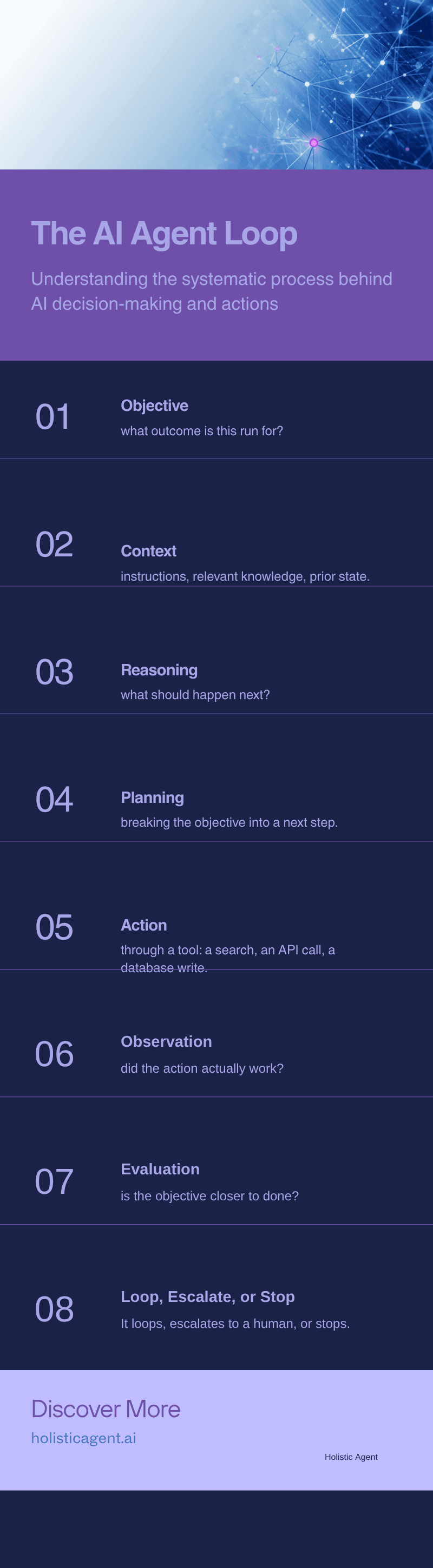
Three things separate a genuine agent from a script wearing an agent's name. The number of iterations isn't known in advance. The loop is grounded by observation — an agent that never checks what actually happened is a text generator with side effects, not an agent. And the loop must have terminators: a step budget, a spend ceiling, a time limit, an escalation trigger. An agent loop without a stopping condition is a defect waiting for an invoice.
AI agent vs chatbot vs automation vs RPA
| Chatbot | Automation / RPA | AI Agent | |
|---|---|---|---|
| Goal of its own | No — responds to input | No — executes a fixed sequence | Yes — pursues a stated objective |
| Handles the unexpected | No | No — breaks on anything unanticipated | Yes, within its permissions |
| Takes real action | Rarely | Yes, but only pre-defined steps | Yes, choosing the steps itself |
| Predictability | High | Very high | Lower, by design |
| Best for | Answering questions in conversation | Known, repeatable processes | Judgement-based work with variable paths |
Types of AI agents
- Reactive agents — respond directly to input with no internal planning step.
- Deliberative agents — plan ahead before acting, weighing multiple possible steps.
- Multi-agent systems — several agents, often specialised, coordinating on one larger objective.
- Autonomous agents — operate with minimal human intervention inside defined boundaries.
In practice, most useful business agents are narrow and deliberative: given a specific job — qualify this lead, resolve this support query, book this appointment — with tools scoped tightly to that job and a human positioned at the points that matter.
What AI agents can do for a business
The theory matters, but the reason agents are being adopted right now is practical: a well-scoped agent can absorb work that used to require a person to read something, decide something, and act on it — customer queries, appointment bookings, lead qualification — without needing every possible situation pre-programmed in advance. Business AI agents covers what that looks like in practice: where agents fit inside a small business, what they can realistically replace, and what still needs a human.
Common mistakes
- Calling every LLM feature an “agent.” This makes it impossible to reason honestly about cost, risk, or architecture.
- Reaching for an agent when a form or a fixed workflow would do. Most business tasks are more predictable than they feel — deterministic automation is often the right, cheaper answer.
- Assuming a working demo means a reliable system. One successful run says almost nothing about how the agent performs across a hundred varied real inputs.
- Believing a newer model removes the need for architecture. It hasn't yet, and there's no evidence it will.